

Dear readers, today we will learn about restaurant dining etiquette. You may know, dining service follows a set of established practices that starts from the moment a reservation is taken through the clearing of the final course. You may wonder, these etiquette practices are limited to formal dining occasions. That’s not true. In fact, all these are applied to every table and every shift.
Reservations
 When taking a reservation, the employee should ask for the guest’s name, the number in the party, the arrival date and time, any preference for smoking or nonsmoking seating, and any special arrangements or requests. When guests with reservations arrive and a wait is necessary, the host should apologize, state the expected wait time, and direct them to the waiting area. Some operations do not seat a party until all members are present. Others hold a reservation for only fifteen minutes. Some properties call guests on the day of the reservation to confirm the time. Some charge a guest’s credit card for a no-show. From industry surveys it is found that U.S. restaurant no-show rate is as high as 20%. That is why holding a reservation against a credit card has become standard practice at many fine-dining and high-demand properties. Coats should be checked before guests are led to their table, leaving seats and table space clear. The maître d’, host, or hostess should ask for seating preferences before leading guests to a table. If the preferred table is unavailable, the host should tell the guests the expected wait and describe their options.
Seating and Napkins
Once guests are seated, the server may place napkins in guests’ laps or allow guests to do so themselves. Despite its prominence in most dining guides, a 2024 YouGov survey of over 1,100 U.S. adults found that only 55% of respondents regularly place their napkin in their lap while dining. Guests should not tuck the napkin under the chin or into any piece of clothing. The one exception is fastening it discreetly under a belt to keep it from falling. The server should not shake the napkin sharply when opening it. Napkins should be placed on the table so guests can pick them up by the nearest edge and unfold them without difficulty.
Drink Orders and Specials
One of the first duties at the table is to ask guests for their drink orders. If a guest prefers not to drink alcohol, the server should not press the point. A nonalcoholic beverage should be offered instead.
Specials and their prices should be announced clearly and at a measured pace, with a brief pause between items to allow guests to consider each one. The pause should not be long enough to become uncomfortable.
Food Sharing and Passing
When guests wish to share an order or sample from another plate, the server should suggest having this done in the kitchen rather than at the table. If one guest wants to taste another’s food, a small portion can be placed on a plate and passed across, or the plate can be passed over while the other guest takes what is wanted and returns it. Take-home containers are appropriate for most meals but not at formal dinners or banquets.
Attracting the Server
Whistling, clapping, snapping fingers, striking a glass or cup, stamping feet, and other noises to attract a server are not appropriate. Turning toward the server and raising one hand is a sufficient signal. If the server is close by, a quiet “server” is also acceptable.
Handling Unwanted Items
When a guest is served something they must avoid because of an allergy or dislike, the correct response is to leave the item and eat the rest of the dish without comment. You as a waiter should realize that such concern is sometimes a confirmed food allergy rather than a personal dislike. In such case, the guest should quietly notify that to waiter or server, so that the kitchen can prepare a safe alternative and prevent unintended cross-contact. If something must be removed from the mouth, the guest should bring it forward gently and place it on a fork or spoon before setting it on the plate. A small item such as a fish bone may also be removed with the fingers. Inedible items should not be spit out. They should be removed as quietly as possible and placed on the plate. If a guest notices something inedible on a dish, the matter should be raised quietly with the server for removal. If an item is dropped on the table, a fork or spoon should be used to lift it onto a plate. A large spill requires the server’s attention; the server cleans it up and covers the area with a clean napkin.
Passing Items at the Table
Guests should not reach across the table. They should ask to have items passed. When handing a serving dish to another guest, the one passing it should hold the dish steady while the other serves themselves. To transfer a solid item from a serving dish, the guest should use the provided spoon and fork together to lift the item and carry it to the plate. Items with handles should be passed with the handle pointed toward the receiving guest.
Butter and Condiments
Butter and similar items are often served in small covered containers. The guest should lift the cover, take a pat with the knife or fork provided, place it on the butter plate, and replace the cover. The same applies to jams, jellies, and other solid or semisolid items. The server should remove and replace empty containers promptly.
Timing the Meal
Ideally, no one starts until everyone has been served – but in a large group that can leave some food cold. In that case, guests should begin as soon as they’re served, and those still waiting will usually urge the others to start. Servers should try to serve everyone in a party at once. They may wait until all guests have finished a course before clearing, though there’s nothing wrong with removing one guest’s plate while another is still eating; some guests dislike sitting with used dishes in front of them. When in doubt, the server should simply ask, “May I take your plate?
Flatware and the Order of Use
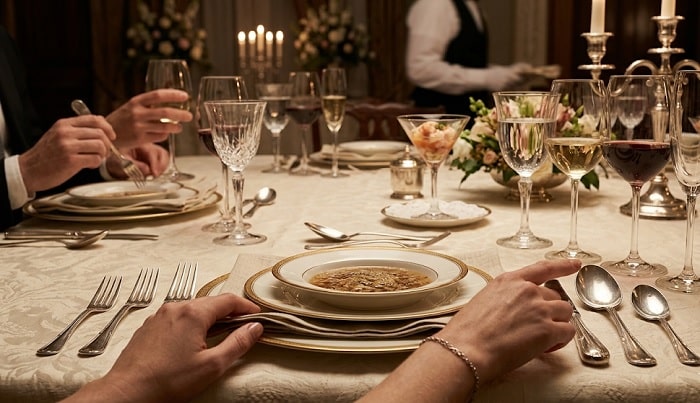 In formal dining especially, each utensil has a precise place and purpose. Knives and spoons sit to the guest’s right, forks to the left. Americans typically cut a piece of food and then move the fork from the left hand to the right to eat, the so-called zig-zag method. Europeans skip the switch, keeping the fork in the left hand to carry food to the mouth. To hold a fork for cutting, a guest keeps it at about a forty-degree angle with the tines pointing down and the food held beneath them; the thumb sits underneath, the second finger supports the right side of the handle, and the index finger presses down on top. Using the fork to nudge food toward a sauce before eating is acceptable, and only small amounts should be taken at a time. Some guests talk with their hands. Servers should watch for this to avoid spills and burns, and should announce that service is coming so that guests are warned. Guests, in turn, should avoid pointing or gesturing with their utensils, especially when there is food on them.
When the menu is fixed, as at a banquet, the table is set in advance with every piece of flatware the meal requires. At a formal dinner a guest may face as many as a dozen pieces and wonder which to use first and what goes with each course, and most people are too embarrassed to ask. The rule is to start with the utensil farthest to the outer right or outer left and work inward, so that by the final, dessert course only the dessert spoon and fork remain, and these may be set above the place setting rather than to either side. Sometimes the first utensil arrives with the food itself; a shrimp cocktail, for instance, may come with a small cocktail fork already on the plate.
Glassware follows the same outer-to-inner rule. Guests are sometimes unsure whether to reach for the right or left outer piece, and the server should help. Although flatware is usually laid out in order of use from the outside in, exceptions occur. A teaspoon may sit on the outer right with the soup spoon just inside it; if the first course is soup, the guest skips the teaspoon and picks up the soup spoon.
When a guest has finished, the knife and fork may be laid together on one side of the plate, pointing the same way; a more traditional finish crosses them in the middle of the plate. Used flatware should never be set on the table, as everything should rest on a plate. Servers, in turn, should not expect guests to reuse flatware; clean pieces come with every new course. When drinking, guests should keep their fingers off the rim of the glass, and goblets and other stemmed glasses should be held by the stem.
Foods That Need Special Handling
Many foods call for particular treatment, and some require special utensils, dishes, or service to manage properly. A lobster bib, a finger bowl, or a special piece of flatware may be in order, and some dishes need their own condiments or sauces. Servers should know what each of these foods requires so that guests can eat them comfortably. Often, simply serving a dish correctly does much to help a guest manage it, even one they have never eaten before. If a guest does not know how to eat something, there is no shame in asking; a guest who would rather not ask can wait, watch what others do, and follow.
Finger Foods
At receptions, cocktail parties, and similar events, guests often eat and drink standing up, sometimes needing an acrobat’s balance to manage a plate, a glass, and a bite at once. Planners should set out tables and chairs where guests can sit and eat, or at least provide small stands where they can rest a drink while eating. Without somewhere to put empty plates and glasses, guests will not carry them far, and the dishes end up on armrests, in planters, on bookshelves, and anywhere else they do not belong, so plenty of small bus stands help. Moist and greasy foods leave fingers sticky, so napkins should be kept plentiful; servers may also offer finger bowls or small cloths dipped in hot water and wrung dry. When a food comes straight from the kitchen and is very hot, the server should warn guests to wait before biting in. Items served with a small pick are easier to handle and keep the fingers clean.
The standard plate for cocktail service is the five-inch bread-and-butter plate, with or without a doily. Guests may serve themselves from a buffet, or servers may pass food through the gathering on trays. Dips and sauces should be served with the expectation that an item is not dipped a second time after it has been used. Guests should take care to avoid spillage.
At picnics, foods such as hot dogs, hamburgers, and tacos are often served wrapped in a napkin to hold them together and minimize spills; frozen desserts benefit from the same approach. Beef and pork ribs are eaten with the fingers. Because rib sauce is sticky, extra napkins or a small moist towel should be provided. Other heavily sauced barbecued meats should receive the same service. A finger bowl at the end of the course is appropriate where the operation provides them. If shish kebab or a similar skewered item is served, the guest should lift the skewer by its handle and use a fork to push the pieces of food onto the plate. The skewer is then set on a plate to the side.
Soups
Soup is served in a bowl or a cup. A cup with two handles may be lifted to drink the last of a thin soup, but this works only for thin soups. Drinking from a bowl is uncouth, as is blowing on soup to cool it. Instead, the guest takes a spoonful and holds it until it cools. Croutons should be served with a spoon rather than the hands. Crackers are better eaten separately, though breaking them up over the soup is not improper.
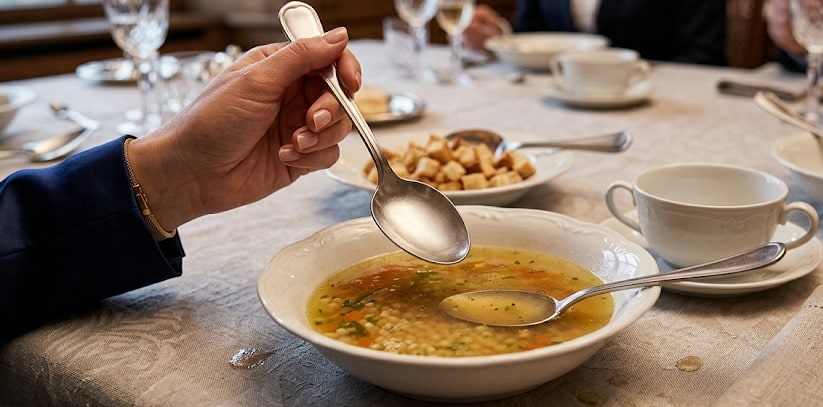 Soup spoons are larger than other spoons. The spoon is moved across the bowl away from the guest, and to reach the last of the soup it is not improper to tip the bowl away and spoon up what gathers on the far side. When finished, the spoon is left in the bowl rather than on the table.
Breads
Bread is served as rolls, in slices, or in whole loaves. A loaf should come on a cutting board with a serrated knife and a napkin for holding it steady while cutting.
Vegetables
Most vegetables are easy to handle, though a few are not. Corn on the cob, after seasoning, may be held with one hand, both hands, or small cob holders set in the ends. Artichokes are eaten leaf by leaf, dipping the tender end in a sauce and drawing the soft flesh off with the teeth before setting the leaf on a plate, which should be provided. The heart is covered with a layer of thistles, which the guest scrapes away before eating the heart with a knife and fork. Asparagus may be eaten with the fingers, but a fork and knife are more proper. A vegetable may come with its sauce already on the plate, or the sauce may be brought to the table in a sauce boat. The server should ask whether the guest wants sauce and how much, or leave the boat so the guest can add more.
Salads
A knife may be used to cut large salad leaves, vegetables, and meats. When salad is served as the first course but a guest prefers it with the main meal, the server should move it to the guest’s left. Some guests eat part of the salad first and then ask to keep the rest for the main course, in which case the server again moves it to the left. If a guest asks for dressing on the side, the server should bring it in a small container and set it beside the salad or on a small plate.
Pasta
Long pasta may be eaten by twisting a small amount around the fork while supporting it with a large spoon, or by setting the fork almost upright against the plate and turning it until it gathers the amount wanted. Some guests take a portion and bring it to the mouth without twisting, though this is harder, since twisting the pasta around the fork makes each bite smaller and more compact.
Conclusion
I hope you enjoyed this tutorial. The practices mentioned above helps to form a working foundation for dining service. A good waiter or server who has absorbed these practices does not need to stop mid-service to determine the correct response or wonder what to do in difficult situations. When an unfamiliar situation arises, the server just need to apply the relevant principles and adjusts as needed. You should always remember, no training material covers every variation a dining room produces. Service judgment develops through repetitive work and experience. I am hopeful this training tutorial will provides the knowledge base from which that judgment develops.
FAQ Section
- Which fork do you use first at a formal dinner? Answer: Start with the utensil farthest from the plate and work inward toward the plate with each course.
- What is the Continental style of eating and how does it differ from the American style? Answer: In the Continental style, the fork stays in the left hand with tines pointing down throughout the meal whereas in the American style, the diner cuts with the fork in the left hand, then switches the fork to the right to eat.
- What should a guest do if server give something they have a food allergy to? Answer: As a guest you should quietly notify the server so the kitchen can prepare a safe alternative. Do not simply leave the item untouched, as cross-contact remains a risk.
- What is the proper or polite way to signal a server at a restaurant? Answer: You may turn toward the server and raise one hand. Always remember that whistling, clapping or snapping fingers is not appropriate.
- Is it acceptable to start eating before everyone at the table is served? Answer: In smaller groups, you should wait until everyone has been served. In large groups, you may begin as soon as your food arrives to avoid letting it go cold. Other guests will typically encourage you too to start.
